
Your Life,
Joined Up.
Government records about your health, income, schooling, housing and family are being joined together across agencies.
Some of those records now help decide what investors get paid. Some NDIS records are shared with a fraud taskforce. You can’t get your information taken out of the National Disability Data Asset.

NSW has linked records on every resident born on or after 1 January 1990, and their families.[1]
Children in one 2020 version of the NSW Human Services Dataset, across 135 datasets from 11 agencies.[2]
Documents about the NDIA and Palantir that the agency refused to release.[3]
The Future Fund’s shareholding in Palantir at 30 June 2026.[4]
Where Your Records Go
Joining records was part of the investment plan from the start. In 2017, Morrison and Porter said linking Commonwealth and state records would help find more investment opportunities.[5]
A simplified picture. Each system has its own legal powers and permitted uses, so they need to be named separately. Scroll sideways on a phone.[6][7][20][21][28][29][30]
What’s in PLIDA, and since when
Selected records held in the ABS Person Level Integrated Data Asset
NDIS data covers participants’ primary disability and the services they received. Source: Australian Bureau of Statistics.[6]
| NSW Human Services Dataset | ABS PLIDA | National Disability Data Asset | |
|---|---|---|---|
| What’s in it | NSW and Commonwealth records on children, young people and families: child protection, out-of-home care, police, health, schools, housing.[8][2] | Tax, Medicare, medicines, Centrelink, Census and NDIS records, among others.[6] | De-identified records on employment, income, health, education and support services.[9] |
| What it’s used for | Projecting future service use and estimating return on investment.[8] | Research and policy analysis under specific laws.[6] | Approved research about disabled people’s experiences and programmes.[7] |
| Can you opt out? | Not stated. | Not stated. | No. “You will not be able to access, change or remove information about yourself.”[9] |
From a Record to a Payment
Commonwealth records are already part of the payment machinery for social impact trials.
Foyer Central houses young adults who have left out-of-home care. A social impact bond paid to set it up. The Department of Social Services says Commonwealth data will help measure successful outcomes in the 12 months after a person moves out.[10]
For South Australia’s Newpin, Commonwealth payments depend on children being reunited and still living safely with their families 18 months after starting. There, Commonwealth data supports the evaluation.[10]
Those are two different uses of the same kind of record. The agreements and payment formulas are needed to see the exact route from a record to an investor’s return.
Each step in that route is a choice someone makes. A hospital admission, a few months in work or a child’s placement can change the result, and each choice can change the money owed.
People getting the service should know which of their records will be linked, and what money depends on them.
Pick the group
Who gets the service and who counts.
Pick the result
A hospital admission, a job, a child’s placement.
Guess the alternative
What would have happened without it.
Do the sums
The records decide the payment.
Pricing Children’s Futures
NSW uses the Human Services Dataset to project which services people will use in future, and what that will cost. Its Forecasting Future Outcomes model can be used to estimate return on investment.[8]
Records about children and families now feed forecasts of services they may need years from now.
“19% of children and young people in NSW are expected to experience the poorest outcomes later in life and make up around 50% of the total estimated future cost.”
NSW Government, Investment approach for human services[8]
No Opting Out
“You will not be able to access, change or remove information about yourself from the disability data asset.”
National Disability Data Asset privacy statement[9]
The data asset’s managers say they can’t remove you because your identity is no longer known. Identifiers are kept separately, approved researchers get controlled access, and detailed data has to stay in Australia.[9]
Those rules limit who sees what. They don’t give you a say over each new research project, or a way to withdraw. Fixing a mistake at Centrelink or the NDIA is a different job from controlling what happens to the combined data.
What the charter says it can’t be used for
- “to identify people for any purpose”
- “to make decisions about an individual’s access to government funding”
- “in automated decision-making tools for compliance purposes like debt raising”
Source: NDDA Charter.[7] The questions now are which projects get approved, who gets access, how breaches are caught, and whether these limits get widened later.
NDIS Records and the Fraud Taskforce
In September 2026, the Guardian reported that the NDIA confirmed it shares participant information with the Fraud Fusion Taskforce “on a restricted basis where potential criminal conduct is suspected”.[11][12]
The Australian Criminal Intelligence Commission, one of the taskforce’s member agencies, has used Palantir’s analytics platform. The Guardian described a 25-agency taskforce; the NDIA’s own page lists 19 members.[28] The reporting raised the possibility that NDIS data ended up there. It did not establish that every participant’s file did.[11][12]
The NDIA has no direct Palantir contract. But through the taskforce, financial intelligence about NDIS participants and providers goes to AUSTRAC and the ACIC, and both of them do.[31] Crikey counted more than $60 million in Commonwealth work for Palantir across five agencies, with Defence the biggest spender at $31 million.[30] In November 2025 Palantir announced it had reached the IRAP PROTECTED level, the security rating it needs to handle sensitive government information, opening its Foundry and AIP products to more Australian agencies.[29] The Australian Signals Directorate says that rating is not government approval of “a company’s broader conduct or use of data”.[32]
Being flagged as a fraud risk can change how you’re treated long before anyone is charged. A name in an analytics system is not proof of an offence.
The NDIA’s Palantir documents
An FOI request found 31 documents about Palantir correspondence and possible uses of its products, including meetings and proof-of-concept material. Decision dated 14 August 2026.[3]
Meanwhile, the Future Fund held $114.6 million in Palantir shares at 30 June 2026. That’s a public investment in the company. It doesn’t show the NDIA bought a Palantir product.[4]
Veterans Got the Same Treatment
581,139 Australians told the 2021 Census they have served, or are serving, in the Australian Defence Force.[13]
On 5 October 2026, Four Corners’ “Defenceless” showed for-profit providers going after veterans with ads and phone calls, offering “free” services and treatments paid for by DVA.[14] One network, Veteran Benefits Australia, ran to more than 70 companies. In a 2022 internal email, a founder boasted its database held the details of 180,000 veterans.[15]
One veteran’s prescribing doctor applied to DVA to raise his cannabis dose from 25 mg of THC a day to 1,220 mg, without speaking to him first.[14]
DVA says the conduct reported to it includes overcharging, kickbacks, misleading advice, undeclared conflicts of interest and putting commercial interests ahead of veterans’ wellbeing.[16]
“It is not in the best interests of vulnerable veterans for these corporations to operate in this manner, yet they are doing so without oversight.”
Dr Margaret Faux, lawyer and medical billing expert, speaking to Four Corners[15]
Find out how this links to Australian Government and private equity roll-ups, all paid for with public money.
Read The Buy-upsThe Cap Came Off. The Operators Stayed.
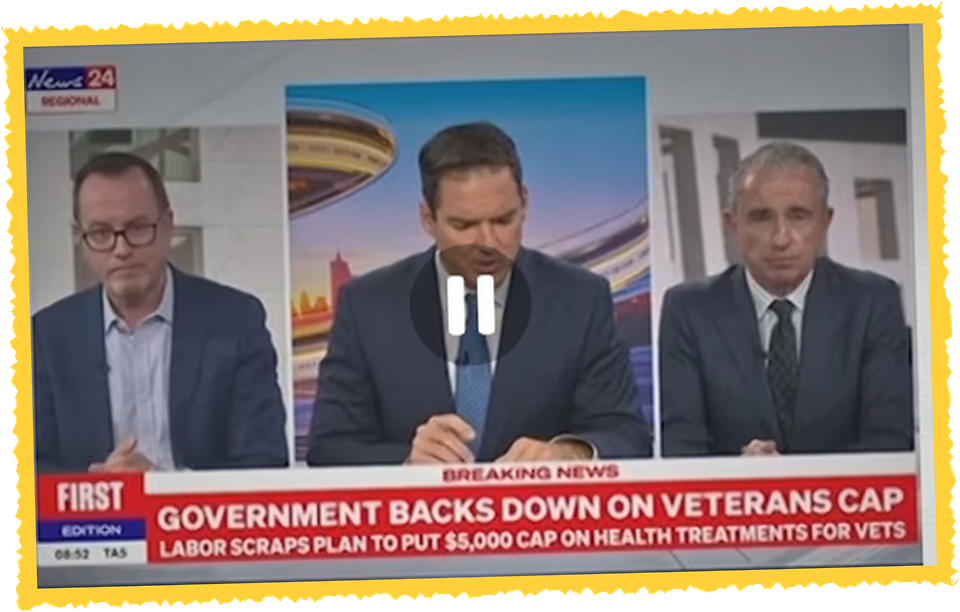
The May 2026 Budget proposed a $5,000 yearly limit on each veteran’s allied health care, such as physio, OT and podiatry. The government said it would save about $750 million over three years and deal with over-servicing. Senate estimates heard of one dietitian charging a single patient $101,000 in a year.[17]
On 17 September 2026, Veterans’ Affairs Minister Matt Keogh took the $5,000 threshold “off the table”.[18] The cap would have applied to every veteran’s care. It did nothing about the businesses doing the over-charging.
Four Corners, “Defenceless”, ABC News In-depth.
One company’s database
Veterans’ details a founder claimed to hold, against everyone who has served
What Is Vertical Integration?
It means one group of companies owns every step you go through.
- An ad or a cold call finds you.
- A “free” advocate lodges your DVA claim.
- A doctor in the same network refers you on.
- The network’s clinics, therapists or prescribers treat you.
Each step sends you to the next step in the same group, and DVA pays at every step. Nobody independent checks whether you needed it.
RSL Australia wants action against the Four Corners providers “that sell vertical health services – and veterans’ data!”[19]
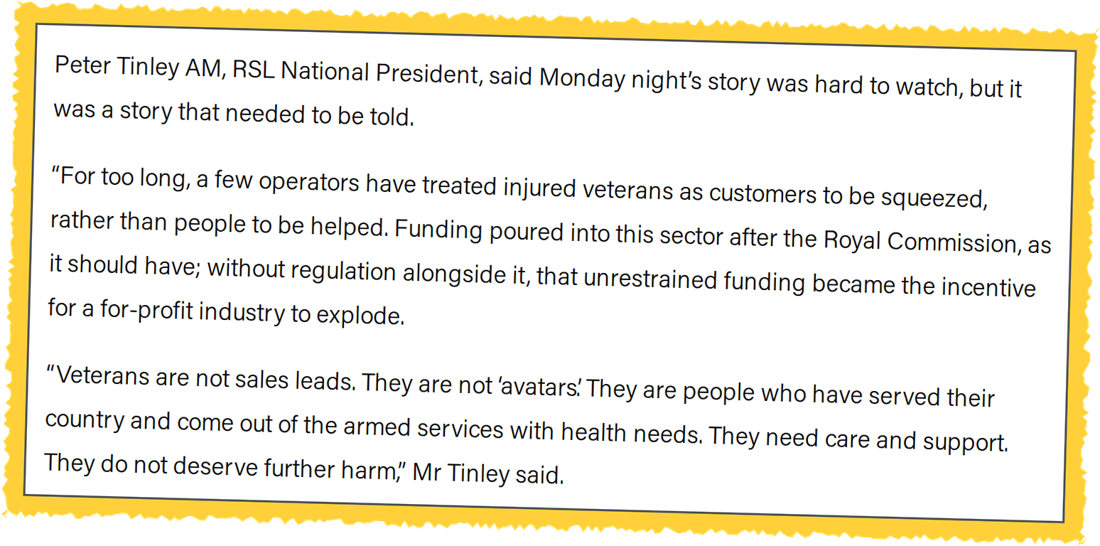
Peter Tinley AM, RSL National President, 6 October 2026[19]
It’s All the Same, and It’s All Care
Childcare, aged care, disability and veterans’ care run on the same pattern: public money goes in, records get joined up, and private operators move in.
| Childcare | Aged care | Disability | Veterans | |
|---|---|---|---|---|
| Public money | Child Care Subsidy | Aged care subsidies | NDIS | DVA services and compensation |
| Records joined | Enrolment and attendance in PLIDA[6] | National Aged Care Data Asset, the Clearinghouse, the National Health Data Hub and every assessment[20][34][35] | PLIDA and the National Disability Data Asset; fraud taskforce sharing[6][11] | DVA records in PLIDA since 2022; a National Veterans’ Data Asset from 2026[21][40] |
| Who’s cashing in | Affinity Education lists a Future Fund holding vehicle among its controlling shareholders[22][23] | Bain Capital grew Estia Health from 73 to 93 homes, then agreed to sell it[24] | Investors expect disability housing returns to stay “relatively protected”[25] | A network of more than 70 companies billing DVA[15] |
What They Hold on Older People and Veterans
The NDIS isn’t the only system joining your records. Here are the main ones for aged care and veterans.
Aged care
Run by the AIHW. More than 80 tables of home support, home care, residential care and assessment records, linked to your medicines, GP visits, immunisations, cancer screening, hospital stays, intensive care, NDIS and death records. De-identified. 29 approved projects at April 2026.[20][33]
The AIHW calls it “Australia’s only central repository of national aged care data”. The department sends it a fresh extract every year.[34][33]
Replaced the National Integrated Health Services Information in May 2024. Joins Medicare, medicines, residential aged care, deaths and state hospital records. Open to government and non-government researchers.[35][36]
Assessors record your needs once, including mobility, personal care and cognition. The AN-ACC score sets how much a nursing home is paid for you.[37]
Linked aged care and health records on 3.5 million people from 2002 to 2020, plus 26,600 people in South Australia. Its partners include aged care providers ECH, Silver Chain and Life Care.[38]
The System Governor, the Aged Care Quality and Safety Commissioner and the Complaints Commissioner get “extra authorisations to use and disclose relevant information”.[39]
Veterans
$29.8 million over three years to join Defence, DVA and state and territory records. The ABS gets $10.1 million, DVA $12.9 million and the AIHW $6.8 million. The budget paper doesn’t say whether it will be identified.[40]
Your claims, injuries and DVA service use, linked to tax, Medicare, Centrelink and Census records. Extended to serving members who are DVA clients in July 2026.[21]
Everyone who served at least one day since 1 January 1985 is listed from Defence’s PMKeyS system and matched against death records.[41]
For the Independent Review of Past Defence and Veteran Suicides, the AIHW linked records by name, including mental health screening and transition data.[42]
Services Australia stores the data. Adobe tracks how you use the site. DVA “may use AI technologies” on what you send, including “creating new information based on that analysis”. It shares with Defence, health providers, insurers and contracted claims assessors.[43]
DVA planned a trial of a prototype AI Claims Document Reader with RSL Queensland for the first half of 2026.[27]
- 1997 Aged careRecords start in what is now the National Aged Care Data Asset.[20]
- 2001 VeteransDefence starts its PMKeyS personnel system, later matched against death records for everyone who served since 1985.[41]
- 2010 ChildcareChildren’s childcare enrolment and attendance records, used to calculate fee reductions, held in PLIDA from 2010 to 2018.[6]
- 2013 Aged careThe AIHW sets up the National Aged Care Data Clearinghouse.[34]
- 2014 VeteransThe AIHW and DVA set up a research partnership to build a profile of veterans’ health and welfare.[26]
- 2017 Aged careThe Registry of Senior Australians starts linking aged care and health records, later covering 3.5 million people.[38]
- 2019 DisabilityNDIS participant data held in PLIDA from June 2019.[6]
- 2022 VeteransDVA starts linking its records with PLIDA through its Longitudinal Wellbeing Project.[21]
- 2024 Aged careThe AIHW launches the National Aged Care Data Asset, linking aged care records with Medicare, medicines, hospitals, the NDIS and deaths.[20]
- 2026 VeteransDVA plans a trial of an AI claims document reader with RSL Queensland. In July, its PLIDA linkage is extended to serving members who are DVA clients.[27][21]
- 2026 VeteransThe Budget funds a $29.8 million National Veterans’ Data Asset from 1 July.[40]
- 2026 DisabilityThe NDIA confirms it shares participant information with the Fraud Fusion Taskforce.[11]
Every Data Asset We Could Find
Government calls these joined-up collections of your records “data assets”. These are the ones on the public record.
Linked data assets on people, across the Commonwealth and four states.
Variables in PLIDA alone.[44]
Active projects in the ABS DataLab at 31 March 2026.[44]
Researchers with access, including 19 overseas.[44]
| Data asset | Run by | What it joins | Since |
|---|---|---|---|
| Person Level Integrated Data Asset (PLIDA), formerly MADIP | ABS | Visas and travel, apprenticeships, uni, payroll, tax, rental income, super, Medicare, medicines, disability supports, aged care, Centrelink, births, deaths and early childhood. More than 70,000 variables. | 2006[44][6] |
| Business Longitudinal Analysis Data Environment (BLADE) | ABS | Business tax, trade, patents, employment and insolvency. Can be joined to PLIDA for approved projects. | 2001[45][6] |
| National Disability Data Asset | Department of Health, Disability and Ageing, with the ABS and AIHW | De-identified records on Australians with and without disability, from Commonwealth, state and territory agencies. | Built 2024 to 2025[46][47] |
| National Aged Care Data Asset | AIHW | Aged care records linked to medicines, GP visits, hospitals, intensive care, cancer, NDIS and deaths. | 1997[20][33] |
| National Health Data Hub, formerly NIHSI | AIHW | Medicare, medicines, immunisations, residential aged care, hospitals and deaths. The platform the disability and aged care assets are released through. | Pre-2010[36][48] |
| National Veterans’ Data Asset | DVA, AIHW, ABS, Defence and others | Defence, DVA and state and territory records on serving and former members. | 2026[40] |
| Life Course Data Asset | ABS, led by Treasury and DSS | PLIDA joined to ACT records, South Australian child records, every state’s births register, childcare records and 2021 Census homelessness data. $16.4 million of a $200 million package. | 2023[47][49] |
| NSW Human Services Dataset | NSW Government | Every NSW resident born since 1990 and their families, across 11 agencies. | 1990[1][2] |
| PeopleWA | WA Department of the Premier and Cabinet | Births, deaths, education, health, justice, Communities and WA Police records, plus Commonwealth education data. Up to 75 million records linked at launch. | 2023[50][53] |
| BEBOLD | Adelaide University and SA Government | Every South Australian child born since 1991, and their parents. Feeds into the Life Course Data Asset. | 1991[51][49] |
| Victorian Social Investment Integrated Data Resource | Victorian Government | The whole-of-Victorian-government linked data asset, including family violence records. | Not stated[52] |
Most are released to researchers in de-identified form. That means names and addresses are removed, not that the records stop being about you.
What We Want Released
They’ve got our records. We want theirs.
- Which records are used to trigger payments in each outcomes contract, and the formula that turns them into money.
- Every approved project using linked data, who has access, the contractors involved and how long data is kept.
- The products, data fields, agreements and processing locations behind any Palantir proposal or use, and whether it produces risk scores or predictions.
- How a fraud alert is generated, what checking is required, and who decides to act on it.
- A usable way to fix mistakes in the original records before they follow people into other systems.
- What any supplier can keep, reuse or use to train its models, and how government can audit it and get out.
Sources
- NSW Department of Communities and Justice, Human Services Dataset, frequently asked questions. https://ageingdisabilitycommission.nsw.gov.au/content/dcj/dcj-website/dcj/about-us/facsiar/human-services-dataset-hsds/frequently-asked-questions.html
- ANROWS, Linked data on NSW child protection, domestic and family violence, alcohol and other drugs, and mental health, 2025. https://www.anrows.org.au/publication/linked-data-nsw-child-protection-dfv-aod-mental-health/read/
- NDIA, FOI 25/26-2104, decision dated 14 August 2026 and document schedule, via Right to Know. 31 documents identified; nine released in part; 22 refused. https://www.righttoknow.org.au/request/palantir_3
- Future Fund, Periodic Investment Report, 30 June 2026, Table 1. Palantir Technologies holding valued at $114,610,256. https://content.futurefund.gov.au/Periodic+Investment+Report+30+Jun+2026+-+Future+Fund+(A1435346).csv
- Scott Morrison and Christian Porter, Developing Australia’s Social Impact Investing Market, joint ministerial announcement, 8 August 2017. https://formerministers.dss.gov.au/17344/developing-australias-social-impact-investing-market/
- Australian Bureau of Statistics, PLIDA data and legislation, 2 June 2026. Dataset inventory, start dates and legislative authorities. https://www.abs.gov.au/statistics/data-integration/integrated-data/person-level-integrated-data-asset-plida/plida-data-and-legislation
- National Disability Data Asset, Charter factsheet. Permitted research uses and express prohibitions. https://www.ndda.gov.au/114/NDDA-Charter-Factsheet/index.html
- NSW Government, Investment approach for human services. Describes the Human Services Dataset and the Forecasting Future Outcomes model. https://www.nsw.gov.au/community-services/investment-approach-for-human-services
- National Disability Data Asset and Australian National Data Integration Infrastructure, privacy statement, descriptive transcript, November 2024. https://www.ndda.gov.au/sites/default/files/documents/2024-11/NDDA-and-ANDII-Privacy-Statement_Descriptive-Transcript.pdf
- Department of Social Services, State and Territory Partnership Trials, accessed 6 October 2026. https://www.dss.gov.au/social-impact-investing/state-and-territory-partnership-trials
- The Guardian, NDIS data may have ended up in Palantir’s analytics platform as part of efforts to curb fraud, 9 September 2026. https://www.theguardian.com/australia-news/2026/sep/09/ndis-data-may-have-ended-up-in-palantirs-analytics-platform-as-part-of-efforts-to-curb
- Ability News, Who is sharing NDIS secrets?, 9 September 2026. https://www.abilitynews.org/p/who-sharing-ndis-secrets
- Department of Veterans’ Affairs, Census reveals nearly 600,000 veterans in Australia. https://www.dva.gov.au/newsroom/latest-news-veterans/census-reveals-nearly-600000-veterans-australia
- ABC News, Four Corners investigation into cannabis and ketamine prescriptions in DVA-funded care, 5 October 2026. https://www.abc.net.au/news/2026-10-05/cannabis-ketamine-prescriptions-veteran-health-care-dva/107207132
- ABC News, Four Corners investigation into the Veteran Benefits Australia network, 6 October 2026. https://www.abc.net.au/news/2026-10-06/veteran-benefits-australia-business-empire-four-corners/107208188
- Department of Veterans’ Affairs, Response to ABC Four Corners investigation into veteran support, Defenceless, 6 October 2026. https://www.dva.gov.au/news/latest-stories/response-to-abc-four-corners-investigation-into-veteran-support-defenceless-5-october-2026
- ABC News, Government bows to pressure to scrap allied health cap for veterans, 17 September 2026. https://www.abc.net.au/news/2026-09-17/veterans-allied-health-cap-backflip-government-keogh-lambie/107162722
- Minister for Veterans’ Affairs, Statement on veteran allied health changes, 17 September 2026. https://minister.dva.gov.au/news-and-media/minister/statement-veteran-allied-health-changes
- RSL Australia, Defenceless: Four Corners confirms what RSL has told a Senate inquiry, and the public, for years, media release, 6 October 2026. https://www.rslaustralia.org/latest-news/four-corners-confirms-what-rsl-has-told-a-senate-inquiry-and-the-public-for-years
- AIHW, GEN Aged Care Data, National Aged Care Data Asset. Launched 2024; aged care data from 1997; linked datasets; 29 active projects as at April 2026. https://www.gen-agedcaredata.gov.au/about-our-data/national-aged-care-data-asset
- Department of Veterans’ Affairs, Longitudinal wellbeing of veterans and families, privacy information. https://www.dva.gov.au/about-us/privacy-and-legal-resources/privacy/longitudinal-wellbeing-of-veterans-and-families
- Affinity Education Group, answers to supplementary questions, NSW Legislative Council, received 22 October 2025. https://www.parliament.nsw.gov.au/lcdocs/other/22593/1a.%20ASQ%20-%20Affinity%20-%20received%2022%20October%202025.PDF
- Commonwealth Directory, Quadrant Private Equity No.7C, Future Fund investment holding entity. https://www.directory.gov.au/portfolios/finance/future-fund-management-agency/future-fund-board-guardians/quadrant-private-equity-no7c
- Bain Capital, Bain Capital to Exit Estia Health, 26 May 2026. https://www.baincapital.com/news/bain-capital-exit-estia-health
- For Purpose Investment Partners, Federal Budget 2026–27: Our Read. https://www.fpinvest.com.au/blog-article/federal-budget-2026-27---our-read
- Australian Bureau of Statistics, Data Integration Project Register archive, health and education. AIHW and DVA research partnership established 2014. https://www.abs.gov.au/statistics/data-integration/data-integration-project-register/archive-data-integration-project-register/health-and-education
- Department of Veterans’ Affairs, Vetaffairs, April 2026, Artificial intelligence at DVA. Prototype AI Claims Document Reader trial with RSL Queensland. https://www.dva.gov.au/newsroom/vetaffairs/vetaffairs-vol-42-no1-april-2026/artificial-intelligence-at-dva-supporting-transparency-trust-and-better-services
- NDIS, Fraud Fusion Taskforce. Started November 2022; lists 19 member agencies, including AUSTRAC, the ACIC, DVA and the Department of Health and Aged Care. https://www.ndis.gov.au/about-us/fraud-and-non-compliance/fraud-fusion-taskforce
- Palantir Technologies, Palantir achieves IRAP PROTECTED level, unlocking new opportunities in Australia, 20 November 2025. https://investors.palantir.com/news-details/2025/Palantir-Achieves-Information-Security-Registered-Assessors-Program-IRAP-PROTECTED-Level-Unlocking-New-Opportunities-in-Australia/
- Cam Wilson, Crikey, Calls, messages, police records: How Palantir helped an intelligence agency analyse 42 million data points on Australians, 27 April 2026. ACIC, Defence and AUSTRAC contracts. https://www.crikey.com.au/2026/04/27/palantir-australia-manual-gotham-intelligence-agency-acic/
- Claudia Weisenberger, Michael West Media, Nothing to Hide? Everything to Lose, September 2026. https://michaelwest.com.au/palantir-cellebrite-access-australia/
- Stephanie Tran, Michael West Media, “We kill enemies”: Spy firm Palantir secures top Australian security clearance, January 2026. https://michaelwest.com.au/we-kill-enemies-spy-firm-palantir-secures-top-australian-security-clearance/
- AIHW, National Aged Care Data Asset: data resource profile, February 2026. https://www.gen-agedcaredata.gov.au/resources/publications/2026/february/national-aged-care-data-asset-data-resource-profile
- AIHW, About the National Aged Care Data Clearinghouse. Established 2013. https://www.aihw.gov.au/about-our-data/our-data-collections/national-aged-care-data-clearinghouse/about-national-aged-care-clearinghouse
- Department of Health, Disability and Ageing, Our data collections. NIHSI transitioned to the National Health Data Hub in May 2024. https://www.health.gov.au/topics/health-data-and-medical-research/our-data-collections?language=en
- AIHW, National Health Data Hub, frequently asked questions. https://www.aihw.gov.au/reports-data/nhdh/frequently-asked-questions
- Department of Health, Disability and Ageing, Assessment tools for the Single Assessment System, updated 8 July 2026. https://www.health.gov.au/our-work/single-assessment-system/about/tools?language=en
- Inacio and others, The Registry of Senior Australians: informing aged care policy reforms, 2022. https://pmc.ncbi.nlm.nih.gov/articles/PMC9644842/
- Department of Health, Disability and Ageing, Guide to aged care law, Chapter 7: Information management, updated 13 November 2025. https://www.health.gov.au/resources/publications/guide-to-aged-care-law/chapter-7-information-management?language=en
- Department of Veterans’ Affairs, Budget 2026–27 information sheet, National Veterans’ Data Asset. Implements Recommendation 107 of the Royal Commission into Defence and Veteran Suicide. https://www.dva.gov.au/sites/default/files/2026-05/budget-2026-27-info-sheet-national-veterans-data-asset.pdf
- AIHW, Serving and ex-serving ADF members who have served since 1985: suicide monitoring 1997 to 2022, FAQs, 2024. https://www.aihw.gov.au/reports/veterans/serving-exserving-adf-suicide-monitoring-2024/contents/frequently-asked-questions
- AIHW, Final report to the Independent Review of Past Defence and Veteran Suicides, data sources. https://www.aihw.gov.au/reports/veterans/independent-review-past-defence-veterans-suicides/contents/technical-notes/data-sources
- Department of Veterans’ Affairs, MyService privacy collection notice. https://www.dva.gov.au/access-benefits/about-myservice/myservice-privacy-collection-notice
- Andrew Leigh, Assistant Minister, Address to Maximizing the use of linked and integrated administrative data, 22 May 2026. PLIDA variables and DataLab figures. https://ministers.treasury.gov.au/ministers/andrew-leigh-2025/speeches/address-maximizing-use-linked-and-integrated-administrative
- Australian Bureau of Statistics, Data linkage and integration to improve the evidence base for public policy, 3 February 2025. BLADE 2001 to 2024; PLIDA 2006 to 2024. https://www.abs.gov.au/about/our-organisation/australian-statistician/speeches/data-linkage-and-integration-improve-evidence-base-public-policy-lessons-australia
- Australian Bureau of Statistics, National Disability Data Asset, 16 January 2026. https://www.abs.gov.au/statistics/data-integration/integrated-data/national-disability-data-asset
- Department of Finance, Commonwealth data ecosystem: Integrate. Lists the national data assets and the $200 million May 2023 package. https://www.finance.gov.au/government/public-data/public-data-policy/commonwealth-data-ecosystem/integrate
- AIHW, Annual Report 2024–25, Our services and products. The NHDH is the platform for the NDDA and NACDA. https://www.transparency.gov.au/publications/health-and-aged-care/australian-institute-of-health-and-welfare/australian-institute-of-health-and-welfare-annual-report-2024-25/about-us/our-services-and-products
- Australian Bureau of Statistics, Life Course Dataset and developments, 23 September 2026. https://www.abs.gov.au/about/key-priorities/life-course-data-initiative/life-course-dataset-and-developments
- WA Government, PeopleWA. https://www.wa.gov.au/organisation/department-of-the-premier-and-cabinet/office-of-digital-government/peoplewa
- Linked administrative data can inform policy and practice: an academic–government research partnership in South Australia (BEBOLD). https://www.ncbi.nlm.nih.gov/pmc/articles/PMC9644872/
- Victorian Government, response to the Parliamentary Inquiry into capturing data on people who use family violence in Victoria. https://www.parliament.vic.gov.au/4a45bc/contentassets/5167c3fe630245aab8c5921640869c95/correction-victorian-government-response-to-the-parliamentary-inquiry-into-capturing-data-on-people-who-use-family-violence-in-victoria.pdf
- WA Government, Secure linked data to improve wellbeing of Western Australians, media statement, 2 August 2023. https://www.wa.gov.au/government/media-statements/Cook-Labor-Government/Secure-linked-data-to-improve-wellbeing-of-Western-Australians-20230802